April 17, 2026
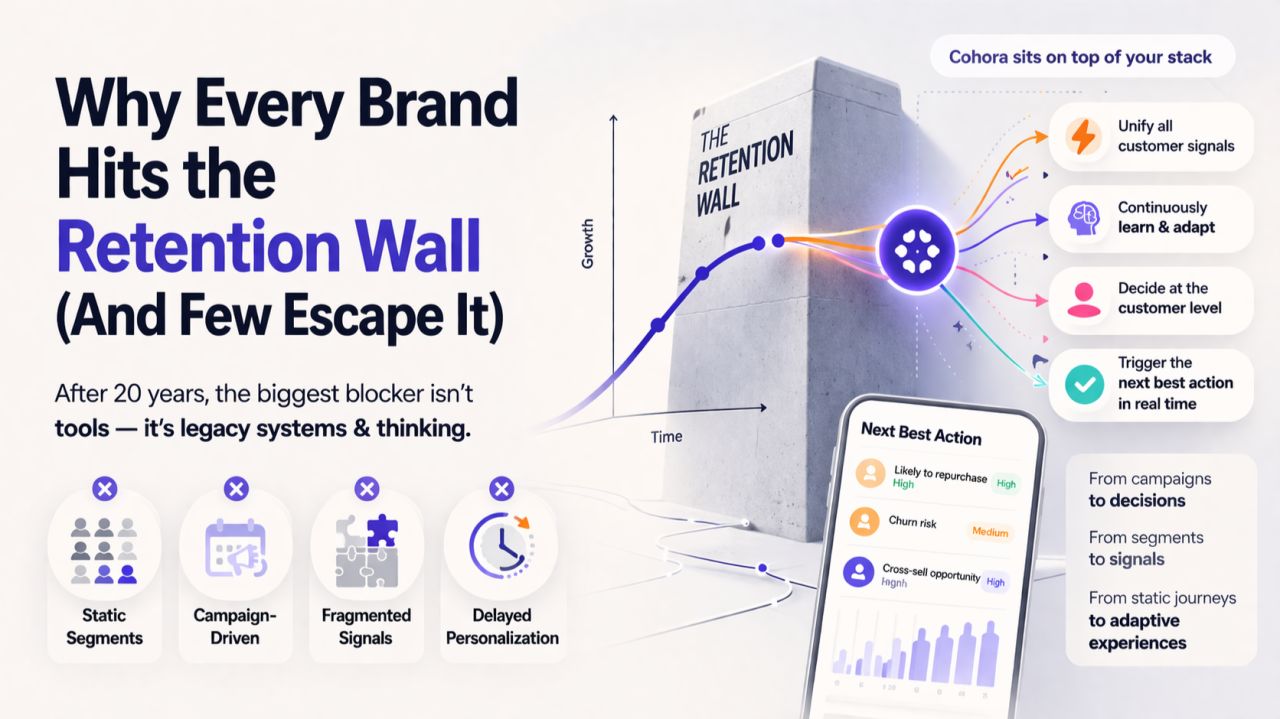
After two decades in this industry, one thing has become very clear to me: some of the biggest challenges brands face today are not new. They are legacy problems we never truly solved, and retention sits right at the center of it.
Over the years, we have added more tools, more channels, and more data, yet the core issue has not changed. Brands are still operating on systems that were built for a completely different era.
And the data reinforces this reality. The average ecommerce retention rate is only around 30–31%, meaning the majority of customers never return after their first purchase. At the same time, returning customers are responsible for 65%+ of total revenue for many brands - an overall observation by Cohora .
So the question is not whether retention matters. It’s why, despite all the investment, brands still struggle to improve it.
Across every brand I work with, no matter how sophisticated their stack appears, I continue to see the same patterns. Retention is still driven by campaigns rather than customer behaviour. Customer signals are fragmented across multiple systems, making it nearly impossible to build a unified view. Personalization remains delayed or static, reacting too late to real intent. Teams are structured to optimise channels and functions instead of being accountable for actual customer outcomes.
Over time, this leads every brand to the same place: a ceiling where performance stops improving. This is what I call the retention wall.
The reason this still exists, even after twenty years of innovation, is because most of what we call progress has been layered on top of legacy thinking rather than replacing it. We took segmentation, campaign calendars, and rule-based journeys and tried to make them smarter, but we never changed the underlying foundation. As a result, we are still solving modern problems with outdated operating models.
To truly unlock retention, brands need something fundamentally different. They need real-time signal processing, continuous learning systems, customer-level decisioning, and a unified view of engagement and transaction data. In essence, they need a completely new operating layer that can adapt as fast as their customers do.
The challenge, however, is that no brand wants to replace their entire stack, rebuild infrastructure from scratch, or disrupt teams that are already in place. And they shouldn’t have to.
This is exactly where Cohora comes in. We built Cohora with a very simple principle in mind: to enable the advantages of a modern, adaptive system without forcing brands to change what already exists. Instead of replacing systems, we sit on top of them. Instead of adding more complexity, we unify signals across engagement, content, and transactions. Instead of relying on static rules, we continuously learn from customer behaviour. And most importantly, we trigger the next best action automatically, in real time, without disrupting current workflows.
The impact of this is not theoretical — it is measurable and aligned with broader industry benchmarks measured by Cohora’s current experience:
• Returning Customer Rate increases, with personalized experiences driving up to 56% repeat purchase rates and existing customers showing a 60–70% probability of purchase vs 5–20% for new users
• Average Order Value improves significantly, with recommendation-driven sessions seeing up to 369% higher AOV and contributing to up to 31% of ecommerce revenue
• Customer Lifetime Value expands, with personalization driving 33% higher CLTV and up to 2.1× lifetime value growth
• Reactivation becomes predictable, with personalized journeys delivering up to 6× higher transaction rates and recovering abandoned demand
Even a small improvement in retention has an outsized impact. A 5% increase in retention can drive 25% to 95% profit growth.
This is where the shift happens. Retention stops being reactive and campaign-driven, and becomes a system that continuously learns and adapts with every customer interaction.
After twenty years in this space, I can confidently say that the biggest blocker is not a lack of tools or technology. It is the weight of legacy systems and legacy thinking that holds brands back.
The brands that will win in the next phase are not the ones adding more layers to their stack.
They are the ones that quietly replace how decisions are made, without breaking everything else.

.svg)