June 15, 2026
Most ecommerce retention strategies are measured through repeat purchases, loyalty redemptions, and promotional performance.
But another metric is becoming increasingly important: returning engagement.
Returning engagement measures the percentage of customers who voluntarily return to interact with a brand after their initial purchase, registration, or interaction.
In this article, brand experience refers to the ongoing opportunities customers have to engage with a brand beyond transactions. This may include surveys, quizzes, educational content, product feedback, user-generated content, community participation, loyalty activities, and other experiences that provide value between purchases.
Recent cohort data from anonymized ecommerce brands shows customers repeatedly returned month after month to participate in these experiences, engage with content, share feedback, and interact with brands beyond the initial transaction.
One retail-focused engagement ecosystem maintained 65–85% returning engagement across the first several months after registration. A second beauty-focused ecosystem consistently maintained 50–75% engagement retention across multiple customer cohorts.
The data suggests that when brands give customers reasons to participate beyond purchases alone, retention becomes more durable, engagement becomes more consistent, and emotional loyalty becomes easier to build over time.
For years, ecommerce customer accounts have largely served a functional purpose.
Customers log in to:
Once those tasks are complete, the interaction typically ends.
Historically, ecommerce customer accounts have generated relatively low levels of repeat visitation because they primarily serve transactional functions. Customers log in when they need something, complete the task, and leave. There is little ongoing value exchange taking place that encourages customers to return regularly or build a deeper relationship with the brand.
The challenge is that many customer relationships end there as well.
Many loyalty programs successfully incentivize purchases, but they often struggle to create meaningful engagement between transactions. Customers return when they need something or when an offer appears, but there is often little reason to remain connected to the brand in the meantime.
This dynamic helps explain why many loyalty programs accumulate large membership bases while simultaneously struggling with inactive participants and unredeemed rewards.
The issue is not that customers lack interest in the brand. The issue is that most brands give customers very few reasons to return between purchases. When engagement opportunities are limited to transactions and rewards, participation naturally becomes episodic rather than ongoing.
That model is beginning to change.
Increasingly, brands are expanding customer accounts into broader engagement ecosystems where customers can consume content, provide feedback, participate in surveys, contribute user-generated content, engage with communities, and interact with the brand in ways that extend beyond purchasing.
As these engagement ecosystems grow, a new retention metric becomes increasingly valuable: not simply who registered, but who continues returning to participate over time.
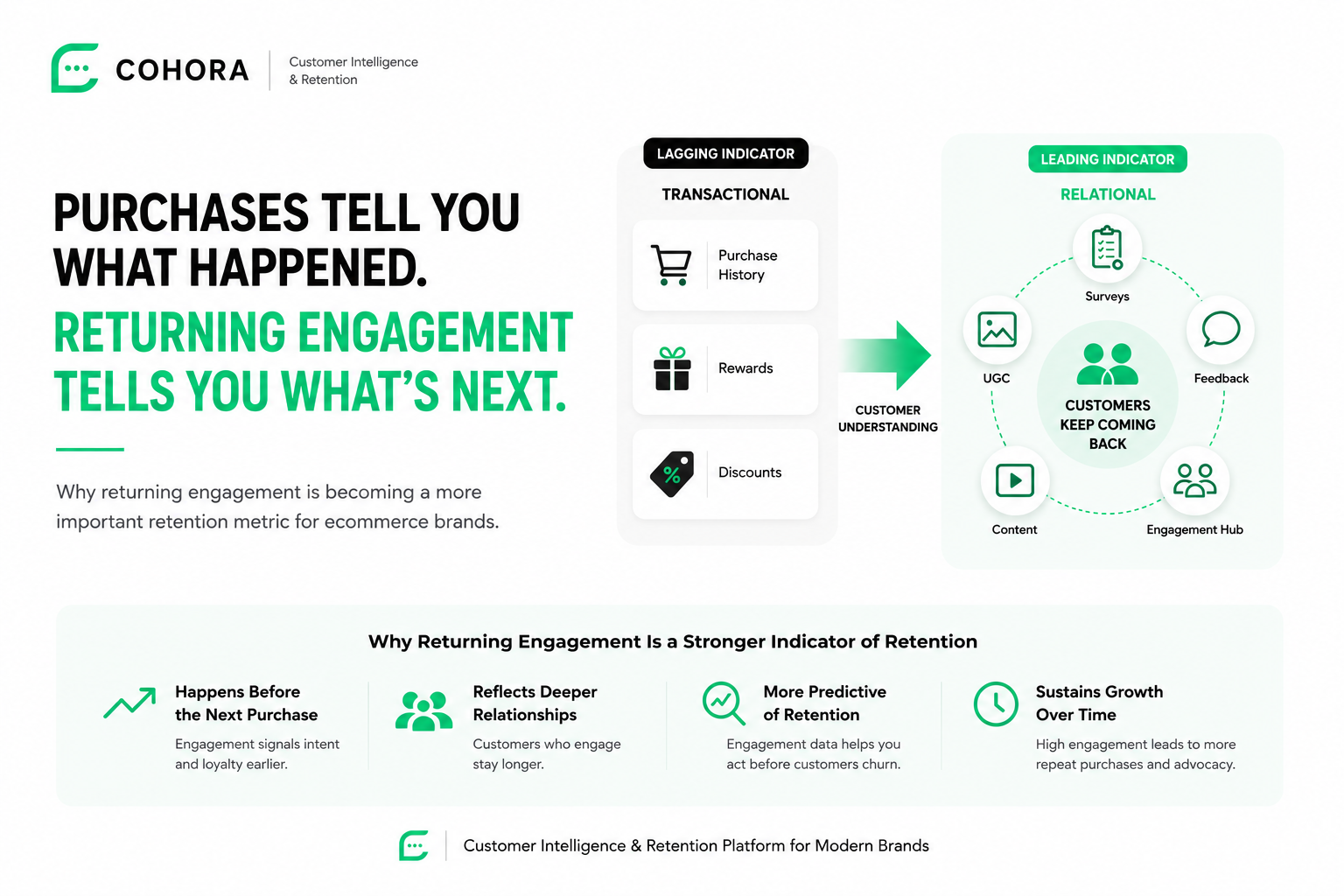
Most retention metrics measure what customers buy.
Returning engagement measures whether customers continue showing up.
Unlike repeat purchase rate, which only captures completed transactions, returning engagement captures the ongoing relationship between a customer and a brand.
Every time a customer returns to participate in surveys, consume content, provide feedback, engage with a community, or interact with a brand ecosystem, they generate signals that indicate continued interest and connection.
This makes returning engagement a valuable indicator of customer health and long-term retention.
While engagement alone does not guarantee future purchases, customers who remain actively connected to a brand often create more opportunities for future transactions, advocacy, referrals, and long-term loyalty.
Customer registrations and account signups only tell part of the story.
The more meaningful metric is whether customers continue returning voluntarily after registration.
That is where returning engagement retention cohorts become valuable.
A cohort tracks how a specific segment of customers behaves over time after joining a platform or experience. Instead of measuring total users alone, cohort analysis measures how consistently customers continue engaging in future months.
In both anonymized ecommerce examples below, customers were not simply registering once and disappearing.
They repeatedly returned to engage with the brand experience over time.

Retail-focused engagement retention cohort data showing sustained monthly returning engagement after registration.
Several retail cohorts maintained 65–85% returning engagement across the first one to three months after registration, with some cohorts continuing to show 50–60% engagement retention after five to eight months.
This level of consistency suggests customers found ongoing value in returning and participating beyond purchases alone.
Rather than treating account creation as a one-time event, customers continued interacting with the brand experience long after their initial registration.

Beauty-focused engagement retention cohort data showing recurring customer participation over time.
The beauty-focused engagement ecosystem showed similar patterns, with many cohorts maintaining 50–75% engagement retention across the first several months after registration.
Longer-term retention remained healthy across multiple cohorts, reinforcing the idea that customers continued returning to interact with the brand experience over time rather than treating registration as a one-time event.
Across both examples, the pattern remained consistent: customers who were given opportunities to participate beyond transactions continued returning at meaningful rates over extended periods of time.
Traditional loyalty programs are largely transactional by design.
Customers spend money.
Customers earn rewards.
Customers receive discounts.
While effective in certain situations, transactional loyalty alone does not always create emotional connection or sustained engagement.
Customers increasingly expect brands to offer:
When brands create reasons for customers to care beyond purchases, engagement behavior changes.
Customers become more likely to return voluntarily, participate more frequently, and remain connected to the brand between transactions.
Emotional loyalty is often more durable than purely transactional loyalty.
A competitor can match discounts or launch a similar rewards program. It is much harder to replicate a customer relationship built through ongoing participation, familiarity, and engagement.
Customers who actively engage with a brand ecosystem are often more likely to:
These behaviors help strengthen long-term customer retention while creating additional opportunities for customer lifetime value growth over time.
As acquisition costs continue increasing, ecommerce brands are under pressure to improve retention efficiency and customer lifetime value without relying entirely on discounts and paid media.
The brands seeing stronger long-term engagement are increasingly focused on creating participation-driven ecosystems instead of purely transactional loyalty programs.
The opportunity is no longer just increasing repeat purchases.
The opportunity is creating experiences customers want to return to repeatedly over time.
The future of retention may not be measured solely by who buys again.
It may increasingly be measured by who continues showing up.
As customer acquisition becomes more expensive and competition for attention intensifies, brands that create ongoing participation will have a significant advantage over brands that only appear when they have something to sell.
Returning engagement is not simply an engagement metric.
It is becoming an increasingly important indicator of customer health, customer loyalty, and long-term retention.
Cohora helps ecommerce brands build stronger customer retention through personalized engagement ecosystems, participation-driven experiences, customer interaction layers, and retention intelligence designed to increase emotional loyalty and customer lifetime value.
Returning engagement retention measures how often customers continue returning to engage with a brand experience over time after their initial registration, purchase, or interaction.
Engagement retention cohorts help brands understand whether customers continue participating and interacting over time instead of simply registering once and disengaging.
Transactional loyalty is primarily driven by discounts and rewards. Emotional loyalty is built through participation, engagement, personalized experiences, and ongoing brand connection.
Brands are increasingly investing in engagement ecosystems because customers are more likely to remain connected when they receive ongoing value beyond purchases alone.
Customers who actively participate in brand experiences are often more likely to return frequently, stay engaged between purchases, and develop stronger long-term relationships with the brand.

.svg)